Poor Baby
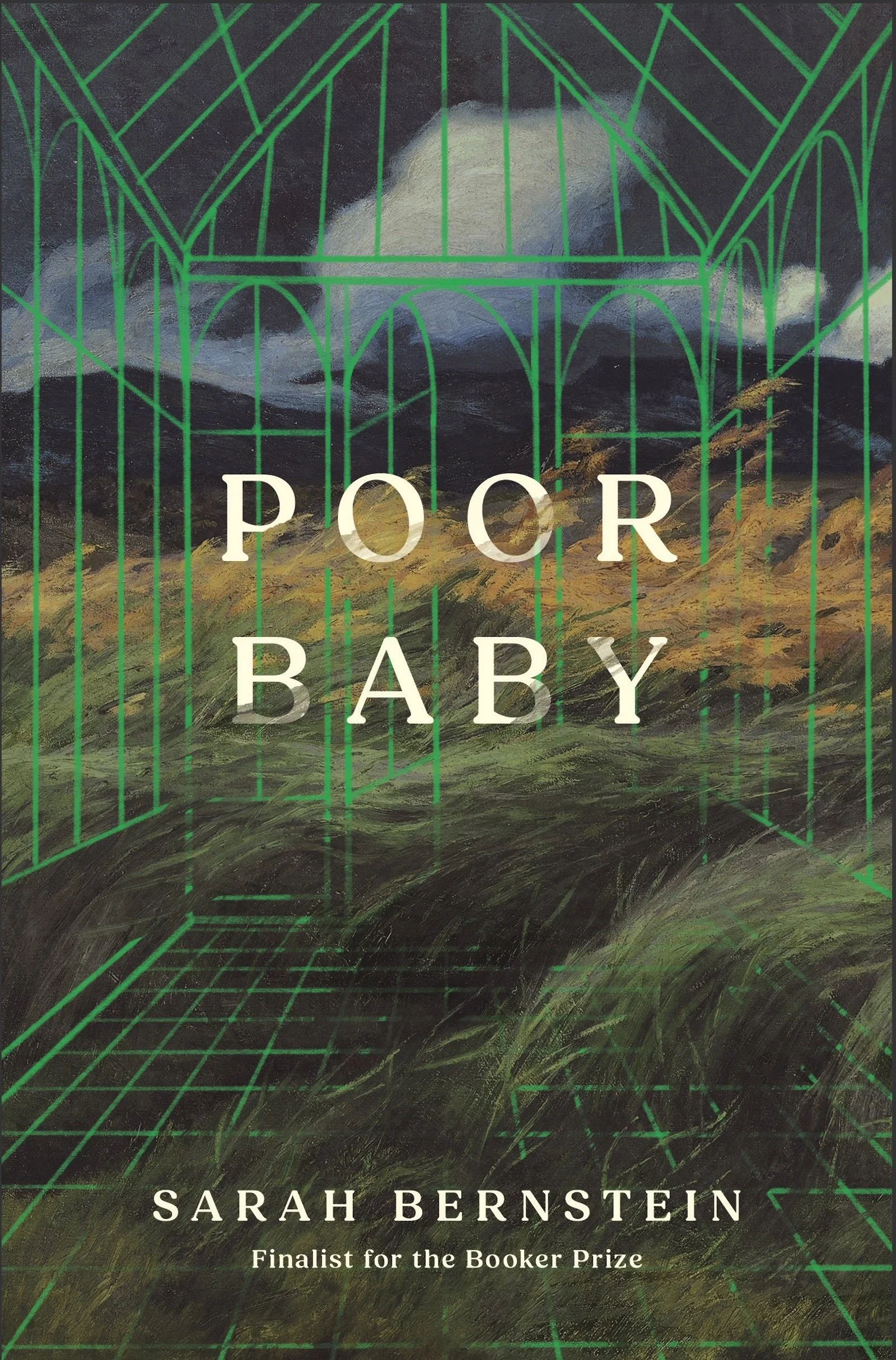
Poor Baby
Sarah Bernstein
One of Granta’s Best of Young British Novelists 2023
From Booker Prize–shortlisted author Sarah Bernstein, a modern Gothic in which a woman newly arrived to a vast estate finds herself besieged by mysterious letters, resonant silences, and the uncanny persistence of history.
At first Emil and I did not know about the big house. Or if we knew about it, we did not think about it, hidden as it was from Westermoy. It was impossible to get an unbroken view of any part of the building, not left to right, not up or down. Sane, not sane, houses such as this one held gravity differently than other buildings.
A woman and her partner arrive at a gamekeeper’s cottage deep in the woods to begin a new life. There, they will undertake an ambitious regenerative agriculture project on behalf of the estate—observing mosses and lichens, planting birch and aspen trees, developing plans to reclaim polluted soils. They learn that soon they will also have their first child.
But even from the first happy evening of their arrival, there are spaces where the woman does not like to tread: an anteroom she passes as quickly as she can, a corner in the raised beds where nothing grows, a glasshouse where she invariably feels watched. Then Emil is called away on business, and letters begin to arrive—strange intimations about the estate, thickets of claim and counterclaim.
They came to Westermoy to get out ahead of their panic, to try to live a “good life”—to focus on what was in front of them, work with their hands, water and mulch. But neither the garden walls nor the boundaries of the estate can contain what has already taken root. The future they are building must also, unavoidably, rest on the past.
A novel of thresholds, secrets, and silences, Poor Baby asks what is left of the world to inherit, and whether it is possible to live ethically within a system one wishes to disavow. It marks the US debut of a major voice in fiction: precise, intelligent, and bracingly new.
Praise for Sarah Bernstein
"Study for Obedience is an absurdist, darkly funny novel about the rise of xenophobia, as seen through the eyes of a stranger in an unnamed town—or is it? Bernstein’s urgent, crystalline prose upsets all our expectations, and what transpires is a meditation on survival itself." —2023 Booker Prize Judges
"★★★★★ One of the year’s best novels... Study for Obedience has a parable's radiance: the air of the consequential, of a cast who represents us all. Yet it's too alive a story to rest on obvious messages... Bernstein's writing is philosophically opaque, as well as electric and elegant. It’s unfortunately fashionable to speak of what novels ‘say,’ to posit that they, and everything else, should convey a single-minded stance. Such childishness melts away before a novel such as this: one that reminds you, beautifully, that fiction is a moral art."—Daily Telegraph (5 stars)
"An atmosphere of dread, surfacing violence, and the uncanny permeates this remarkable novel . . . With so little space to breathe on each page, the reader is utterly transported into Bernstein’s unsettling and unknowable worlds... There is a decided shift away from feminine vulnerability and passivity toward the thrilling anarchic potential of a woman’s agency... Study for Obedience interrogates society's hostility toward outsiders, but the true difficulty of this compelling book lies in its uncomfortable suggestion that when an outcast gains agency, this agency may not be used for society's good."—Financial Times
"Precise and startling... You don't so much read a Sarah Bernstein novel as get trapped inside it... Bernstein has an ambitious style that's entirely her own... Bernstein's energies are poured into shaping the distinctive psychology of her narrator and her equally distinctive prose... Exhilarating."—The Times
"Bernstein was recently named one of Granta’s best young British novelists of 2023, and it’s little wonder. This masterly follow-up to her debut acts as a meditation on survival, the dangers of absorbing the narratives of the powerful, and a warning that the self-blame of the oppressed often comes back to bite."—The Observer
"The Coming Bad Days is raw, dazzling, and bracingly new. A vividly original novel about the fractured difficulty of living.”—Rebecca Tamás, author of Strangers
"Sinewy and seductive. A beautiful, mysterious, existential shudder of a book, and a map of disorientation."—Olivia Sudjic, author of Asylum Road
"The Coming Bad Days is lucid, funny, and darkly alive; a bright knife that refuses to cut out the worm in the heart."—Daisy Lafarge, author of Life Without Air
"An exceptionally sharp, poised novel about the fragility and strangeness of existence. By turns mournful, wry, and starkly beautiful, this is a book to savor."—Megan Hunter, author of The Harpy
"There is something beautiful in the novel's willingness to be in a space of ambiguity... The Coming Bad Days fine-tunes the reader into more sensitive ways of being in the world."—The Guardian
PRoduct info
Publication Date: March 9, 2027
Fiction
Paperback | 5.25 x 8 | 176 pages
Rights: US
9798893380606